Exploring the Unique Minerals of
Franklin & Ogdensburg
The Franklin-Ogdensburg Mineralogical Society, Inc. (FOMS) provides programs designed to benefit the community, mineral collectors, and others interested in the minerals, mineralogy, and geology of the Franklin-Ogdensburg area of New Jersey
About Us
A Society Built on Science, Education
FOMS provides programs designed to benefit the community, mineral collectors, students, and anyone interested in mineralogy and geology. Through education, research, and hands-on experiences, we promote a deeper understanding of the unique mineral heritage of the Franklin-Ogdensburg area in Sussex, New Jersey.
- Permanent Collection
Establish and maintain a museum dedicated to Franklin and Ogdensburg minerals.
- Mineralogical Research
Advance mineral knowledge through scientific cooperation and study.
We support collectors, researchers, and enthusiasts while protecting this remarkable geological heritage.
Accurate Identification
Collect, maintain, and share accurate, up-to-date information while supporting precise identification.
Responsible Collecting
Facilitate ethical mineral collecting, conserve materials for future generations, and promote fellowship.
FAQs
Frequently Asked Questions
Have questions about our mineralogical society, field trips, or membership? Explore our FAQs to find answers about visiting mineral sites, participating in night digs. Membership questions:
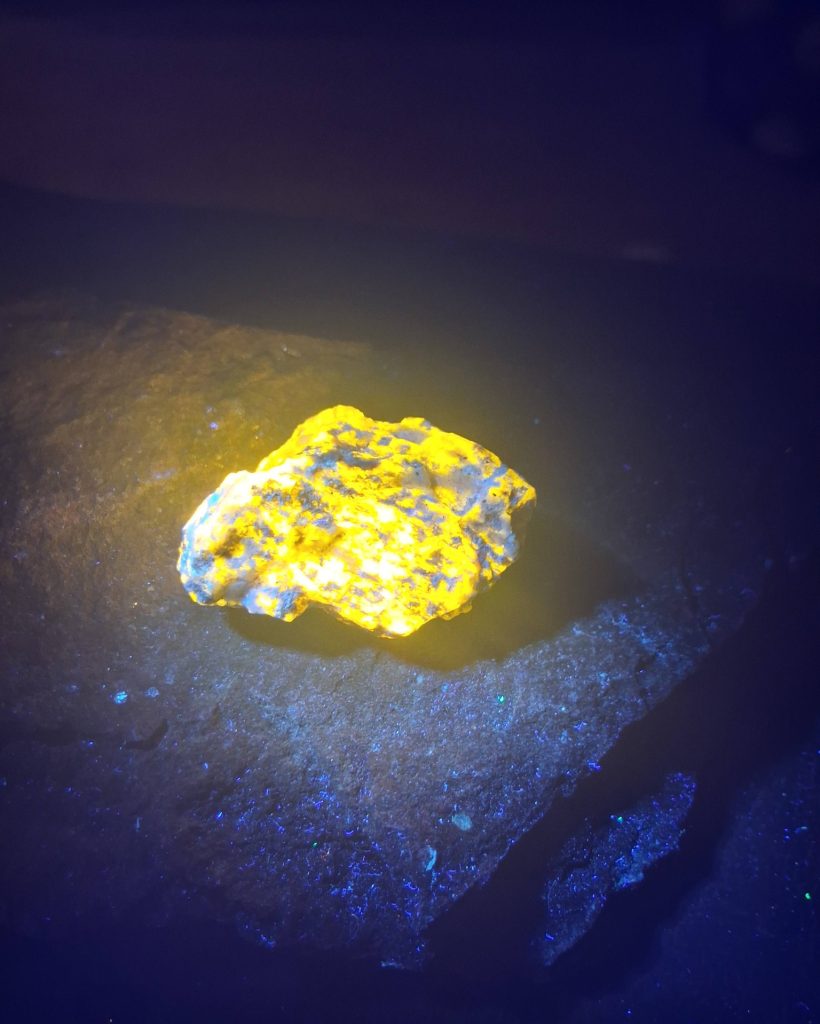
Some minerals found in Franklin, particularly willemite and calcite, have special atomic structures that can absorb invisible UV light and then re-emit it as visible light in various colors. This process is called fluorescence.
Each mineral glows a different color depending on its chemical , composition, tiny impurities (called activators) inside the crystal, and type of UV light used.
Phosphorescence in Franklin minerals is similar to fluorescence, but with a key difference: the glow lasts even after the UV light is turned off. When these minerals absorb ultraviolet light, some of the energy gets “trapped” inside their crystal structure instead of being released right away. This stored energy is then slowly released over time as visible light, causing the minerals to continue glowing in the dark for seconds or even minutes. At the atomic level, this happens because some excited electrons become trapped in “triplet states,” which delay their return to normal energy levels. Certain Franklin minerals, such as white willemites and sphalerites, show this effect, creating a brief afterglow that makes them especially fascinating to observe.
Fluorescence can be understood using a Jablonski diagram, which shows how electrons move between energy levels inside a mineral. When ultraviolet (UV) light hits a fluorescent mineral, it excites electrons from their normal “ground state” to a higher-energy “excited singlet state.” These electrons quickly lose a little energy through vibrations (non-radiative relaxation), then drop back down to the ground state and release the remaining energy as visible light—that emitted light is fluorescence. Because this process happens between singlet states, the transition is very fast (on the order of nanoseconds), which is why the glow appears instantly and disappears as soon as the UV light is removed.
Not all substances are fluorescent – in fact, most of them are not. In substances that do fluoresce, it has been found in most cases that a small amount of some impurity must be present in order for fluorescence to occur. Few chemically pure minerals will fluoresce at all. But on the other hand, the amount of the impurity is critical and if there is too much, the fluorescence will either be diminished or completely eliminated. For example, the red fluorescent calcite from Franklin, New Jersey is activated by manganese in a quantity of about 3%. It has been found that manganese content in the calcite of more than about 5% or less than about 1% will not permit fluorescence. The amount and type of impurity present determine the color and intensity of the fluorescence. The mineral calcite seems to be particularly sensitive to impurity activation and specimens of calcite have been found that fluoresce in practically every color. The amount of activator can be as important as the type.
The following items are highly recommended for collecting fluorescent minerals:
• Sturdy boots, steel-toed work boots
• UV protection safety glasses
• Geologist’s hammer (not a claw hammer)
• Chisel
• Backpack and/or bucket
• A heavy dark cloth or black tarp
• UV flashlights, particularly shortwave (254-255nm) and longwave (365nm)
Ultraviolet light is the portion of the electromagnetic spectrum from 400 nm to about 220 nm wavelength, which is not visible to the human eye. It can be divided into three sub-bands, UVA (315–400 nm); UVB (280–315 nm); and UVC (180–280 nm). Commercial ultraviolet lamps are commonly found in three different wavelengths, they use filter glass to help eliminate visible light emitted by the lamp: UVA or long wave UV at around 360 nm causes many minerals to fluoresce, but other commonly fluorescent minerals may not respond. UVB or mid-wave UV at around 312 nm causes some minerals to fluoresce, it can be a valuable tool for identification. UVC or short wave ultraviolet lamps at around 254 nm wavelength are the most popular for mineral collectors, they cause many Franklin and Sterling Hill minerals to fluoresce brightly. Never look directly into a UV light without UV protective eyewear.
- The Buckwheat Dump at Franklin Mineral Museum
- The Mine Run Dump at the Sterling Hill Mining Museum
- FOMS Dig Events listed on this site